I open other people's doors for a living, and I never step inside
A locksmith does not force a lock open. Five pins are lifted to a shear line and the lock decides on its own terms whether the shape is right. The work is to leave the door as if no one had been at it.
Four thousand doors a year, five pins each, and a stack of other people's leases. I am paid so the last quarter turn looks like it was never needed.
The fourth pin sets before the fifth. It always does, and it stopped being interesting to me years ago.
Twenty past eleven, a dead intercom, a woman in a dressing gown holding her phone flat against the glass so I could read the screen. Tension wrench into the bottom of the keyway, a little pressure to the left, no more than it takes to turn a page. The pick went in. Four pins gave, then the fifth. The cylinder turned a quarter inch, the door came back four inches, and stopped, because her foot was in the way.
She thanked me twice and offered me a bag of oranges. I took one, to be polite, and ate it in the van with the engine running.
A normal door takes me about forty seconds. I do four thousand a year. I have never walked through one of them.
What the tools actually do
There is a version of this work that uses a drill. I have done it twice, both times on a cylinder somebody had filled with glue. A drilled lock is a dead lock. It gets replaced, the door keeps the scar, and the landlord keeps the invoice.
Most of the job is spent not breaking things.
Five pins in the ordinary cylinders, six in the better ones. Each pin is two pieces stacked in a shaft, and the break between the two pieces has to line up with the gap in the housing. That gap is the only thing the lock has ever cared about. Push a pin too high and it binds. Too low and it binds. Level with the gap and it lets go, with a click you feel in your fingers before you hear it.
The lock is not asking who you are. It is asking whether five small breaks are level at the same instant.
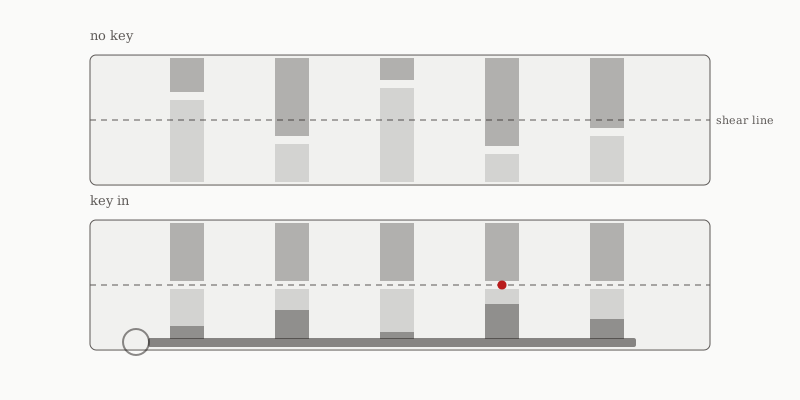
My own standard is not speed. It is that the door, afterwards, shows no evidence that anyone was ever at it. A lock that looks picked is a failed job even when it opened. I have been paid for doors I could have walked away from, and the only part of the invoice that matters is the part nobody can see.
That is also why I do not call it forcing a lock. Nothing gets forced. Five pins are lifted, and the lock decides on its own terms whether the shape is right.
The paperwork
Which is the whole problem, because a lock cannot tell a burglar from a tenant. It has no access to intent, only to depth.
So the trade runs on paper. Before I touch anything I ask for two things: an ID, and something that ties that name to this address. A lease. A utility bill in the same name. A neighbor who looks at the photograph and nods, which is weaker evidence than it sounds, and is usually all there is.
I am not checking a person. I am checking a sheet of paper a person handed me at a door at eleven at night.
One evening a man was waiting for me at an apartment with a lease in his hand. The name on it belonged to a woman. He said it was his wife's, that she was at her mother's, that his keys were inside. Everything he said was plausible. None of it was checkable, the building had no doorman, and the neighbor's door stayed shut the whole time I stood on the landing. I said no.
He stayed out there for twenty minutes without arguing. That was worse than arguing.
I still do not know whether I turned a man away from his own home.
Two cuts, not one
The locks I dislike are the ones in large buildings, because half of them are master keyed. A master-keyed cylinder has two shear lines instead of one. The tenant's key lifts the pins to the lower line. The building's key lifts them to the upper one. One lock, two correct answers, and no opinion about which one you deserve.
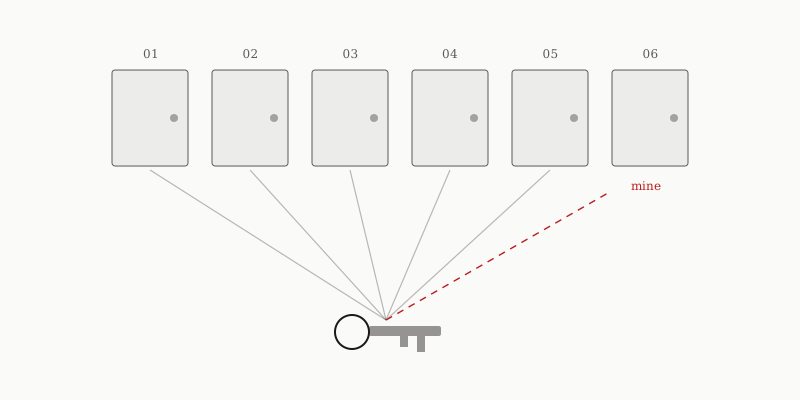
So a lock was never a wall. It is paperwork that happens to have a physical shape. Your key is not proof that nobody else can come in. It is proof that you are on a list.
I keep a board in the van with maybe sixty keys on it, each one for a door I opened once and could not find again. Somewhere in that sixty is a copy of a copy of a copy, and whoever owns the door still believes there is exactly one.
Last March I locked myself out. I stood in my own corridor with a pick set in my jacket and I knocked instead. I have tried to explain that to people and it always comes out sounding like superstition. The man who came took two hours to arrive and would not start until he had seen my ID through the mail slot. He looked at it for a while. Then he opened my door in forty seconds and charged me sixty.
Sixty, for forty seconds, which is the most honest price I have ever paid.