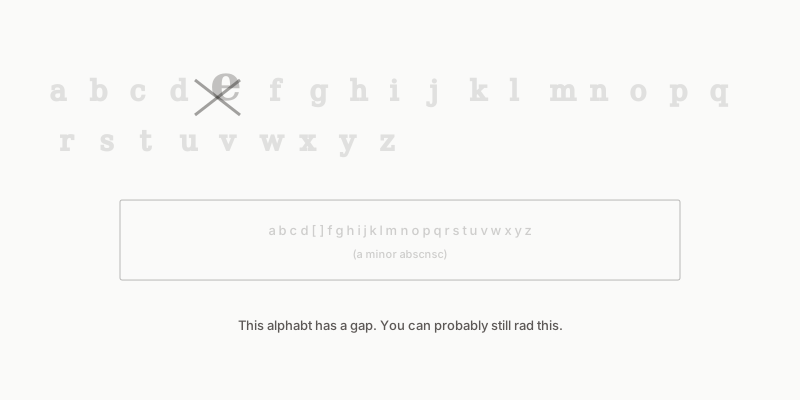
A Short Experiment Without the Letter E
A constraint-writing experiment in English: remove the most common letter from the alphabet and watch how language twists itself into unfamiliar shapes to survive the restriction.
An 800-word constraint: not a singular "e" from start to finish. I found out how far I got about four paragraphs in. That is also part of this post.
I am writing this without a particular symbol. Not a singular "e". My constraint is straightforward in command but brutal in application. Most words in common writing contain that symbol. Many thousands of words vanish instantly.
This first paragraph costs substantial focus. My normal writing rhythm stops, stalls, stutruns. I am doing a symbol scan on almost all words. It is tiring. My brain, artificially, is adapting to a forcing function.
That is what this column is about. Not good writing. Constraint writing.
My word stock
I can still say: "I", "you", "my", "your", "it", "this", "that", "a", "for", "in", "on", "at", "to", "of", "with", "by", "from", "about", "without", "into", "up", "out", "and", "but", "or", "so", "not", "all", "most", "much", "many", "can", "will", "may", "do", "did", "is", "put", "cut", "run", "sit", "go", "look", "know" — all good.
I cannot say: that common short word for a thing; that linking that follows "can" and "will" and "shall"; that pair of first-party nominals split by a consonant; and a long list of additional common words you can probably think of.
List making is handy but also lazy writing. A crutch.
First story try
So: A woman walks into a tall building. A workman at a front station looks up from a book. "Your 2:30 PM is on floor 4. Room 410," says that man.
"Thank you," says that woman.
A short dialog that works. But stylistically it is odd and stiff. No "said," no "at th" plus "at" plus "front plus a word for a flat writing platform", no familiar pronouns for a man or a woman. My substitution: "that man," "that woman." Clunky but functional.
This is what constraint looks and sounds and talks. An awkward gait. A limp.
But a limp is still forward motion.
A slip
Writing this portion, I almost had a slip.
"Numb" plus "symbol for that common linking". Two of that symbol in a word for counting quantifiably by singular units.
I was going to say a "numb" plus "that symbol" plus "r" plus "words" but I caught it at "numb". My brain automatically constructs a normal path, and I must cut it off at startup.
My brain, on a path, will routinally hit words with that symbol, and I will stop and trim and switch. This is tiring but also fascinating. My normal writing follows a smooth forward motion. This constraint turns that flow into a stop-and-start scan.
On utility
Is this post of any utility? Not obviously. It is a limitation display. A writing constraint with no obvious output utility. That is OK for this column.
A thought on constraint
Without "e", my vocabulary pool shrinks by about half. Common plural forms vanish. Almost all past forms involving a suffix vanish. I am stuck in a ongoing now with no past.
Wait, that is not totally right. "I saw" works. "Saw" is S-A-W. No E. "I ran" works. "Ran" is R-A-N. No E. "I did" works. "Did" is D-I-D. No E. Known past forms of common strong nouns work. You just cannot add a suffix.
I was wrong. Constraint thinking is ongoing algorithm work. I cannot simply trust my first thought. I must manually scan and find if my claim is right.
A short story
A girl finds a door in a wall. Not a big door. A small door. For a cat or a fox. On this door, a tiny sign: "for you."
That girl opans that door. On its far anchor, a vast room with no roof, no walls. Only a big, flat, round disk. A stag sits on that disk.
"What is this location?" asks that girl.
"You found it," says that stag. "That is all."
"I know. But what is it?"
"Will you know if I say a word?"
"That is my inquiry."
That stag is still for a full turn.
"That is why you found us," says that stag.
A door in a wall is now a portal, not a door.
Constraint action
Writing without this symbol is a forcing function. You find workarounds, substitutions, contortions. Your writing builds a cautious gait. You cannot flow. You crawl.
But crawling is still forward motion.
This column is about constraint. Not about producing a "good" post — about showing what constraint looks from within.
I did it. A short post with no "e". About 750 words. No slips I can find.
...
Actually. Hold on.
"What about that final illustration caption? That symbol is in that word for a visual aid showing an alphab —"
If you look at that final visual aid citation, I simply talk about its topic without writing a word that contains our constraint symbol.
"Lipogram" — L-I-P-O-G-R-A-M. No E. That is a word for this constraint. A writing form that omits a particular symbol.
Final word count: about 750. Digits, not words. A workaround.
Constraint is not about purity. Constraint is about forcing adaptation. And, for this short post, my writing brain just did that.
No "e". Not a singular "e". I did that.